
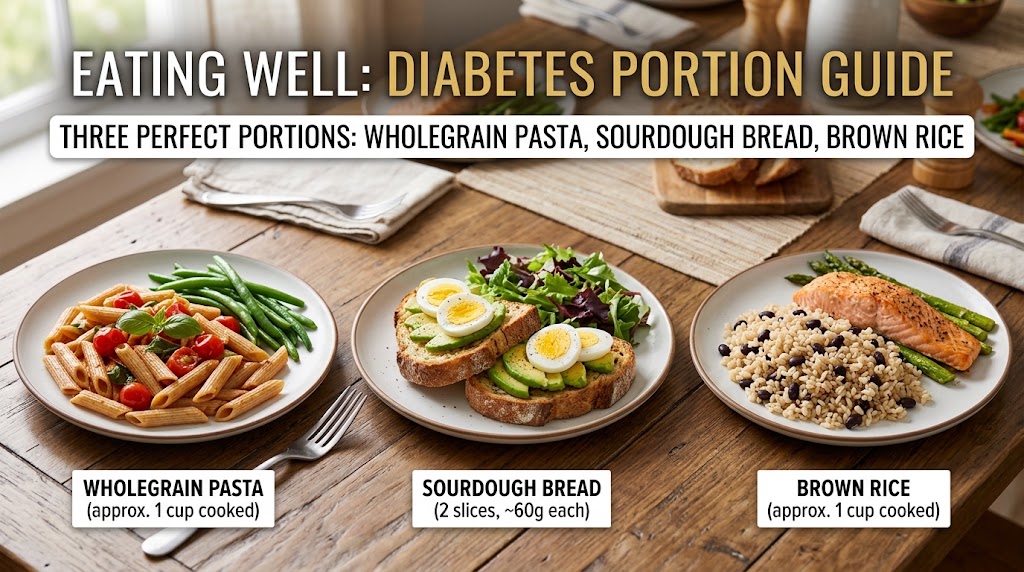
Three of the most common questions people ask when they are first diagnosed with diabetes — or when a family member is — are: can I still eat pasta? Can I eat bread? What about rice?
The short answer to all three is yes. The longer answer — the one that actually helps you manage blood sugar — is that the type, the portion, and what you eat them with all matter considerably. Here is the honest breakdown.
Can diabetics eat pasta?
Yes. Pasta has a lower glycaemic index than many people expect — around 45–55 for standard dried pasta cooked al dente, which is meaningfully lower than white bread or white rice. Cooking pasta to al dente (slightly firm) rather than soft further reduces its GI by making it slower to digest.
The problems with pasta for blood sugar management are usually about portion size and what it is paired with. A large bowl of pasta with a tomato-based sauce provides a significant carbohydrate load. A moderate portion of the same pasta alongside a protein source (chicken, fish, eggs, legumes) and a large salad or vegetable side is a significantly more blood-sugar-friendly meal.
Wholegrain pasta has a slightly lower GI than standard pasta and higher fibre content. Chickpea pasta and lentil pasta have lower GI and higher protein than wheat pasta. These are worthwhile alternatives, though the differences are moderate rather than dramatic.
The single most effective pasta adjustment for blood sugar is simply reducing the pasta portion and increasing the protein and vegetable content of the meal. You are still eating pasta — just in a proportion that works better for your blood sugar.
Can diabetics eat bread?
Yes. But bread varies enormously in its effect on blood sugar, more so than pasta or rice.
White bread has a high glycaemic index (around 70–75) and very little fibre, causing a rapid glucose spike. A piece of white toast on its own on an empty stomach is one of the most reliably blood-sugar-disruptive breakfasts available.
However, the same piece of white toast eaten alongside eggs, avocado, and smoked salmon has a significantly more moderate effect — the protein, fat, and fibre in the other foods slow the digestion of the bread considerably.
Sourdough bread has a lower GI than regular white bread (around 54) because the fermentation process during sourdough production partially breaks down the starch. Rye bread has a GI of around 50 and higher fibre content. Wholegrain bread sits at around 65–70 — better than white but not dramatically different.
If you eat bread regularly and want to manage blood sugar more effectively, switching to sourdough or rye as your default, always eating bread alongside a protein or fat source, and managing your portion to one or two slices per meal rather than multiple are the most impactful changes.
Can diabetics eat rice?
Yes — though rice is the most challenging of the three for blood sugar management. White rice has one of the highest glycaemic indices of any commonly eaten food (around 72), and a standard serving size is large enough to cause a significant glucose response in most people with diabetes.
Brown rice has a GI of around 55 and more fibre than white rice, making it a better option. Basmati rice has a lower GI than standard long-grain white rice (around 57–58) due to its starch structure. Parboiled (converted) rice has a lower GI than regular white rice because its processing changes how the starch is digested.
The most effective strategies for eating rice with diabetes are: choosing basmati or brown rice where possible, reducing the portion to a quarter of the plate rather than half, eating rice with a large amount of protein and non-starchy vegetables to slow its digestion, and using cauliflower rice as a mixer (50% cauliflower, 50% regular rice) to reduce the total carbohydrate load without eliminating rice entirely.
The principle behind all three
Pasta, bread, and rice are all high-carbohydrate foods. None of them are off-limits for people with diabetes. All of them require thoughtfulness about type, portion, and combination.
The combination principle is the most practical: any high-carbohydrate food eaten alongside adequate protein and fat has a significantly more moderate effect on blood sugar than the same food eaten alone. This is not a loophole — it is how digestion works. Protein and fat slow the rate at which carbohydrates are absorbed, reducing the speed and height of the resulting glucose rise.
The goal is not to eliminate the foods you enjoy. It is to eat them in ways that work with your blood sugar rather than against it. GlucoForager's meal suggestions are built around exactly this principle — finding the combinations that let you eat real food while supporting stable glucose levels.
Take the guesswork out of eating with diabetes
GlucoForager is your daily food decision assistant. Scan your fridge, get instant blood-sugar-safe meal suggestions, food swaps, and a daily meal planner — all personalised to your diabetes type and preferences.
Free to start · Premium from $5.99/month · App Store & Google Play